
Dubai’s Mobility Push Is Becoming Impossible To Ignore
Dubai’s latest mobility upgrades are not arriving through one giant announcement. They are happening piece by piece, road by road, station by station.
A new bridge near the World Trade Centre now cuts journey times from eight minutes to two. Meanwhile, Dubai’s first AI-powered smart bus station has officially opened at Mall of the Emirates, introducing fully digital public transport services operating 24/7.
Taken together, these projects reveal something larger taking shape across the emirate. Dubai is no longer simply expanding roads or adding transport capacity. It is redesigning how movement itself works inside the city.
A New 500-Metre Bridge Opens Near World Trade Centre
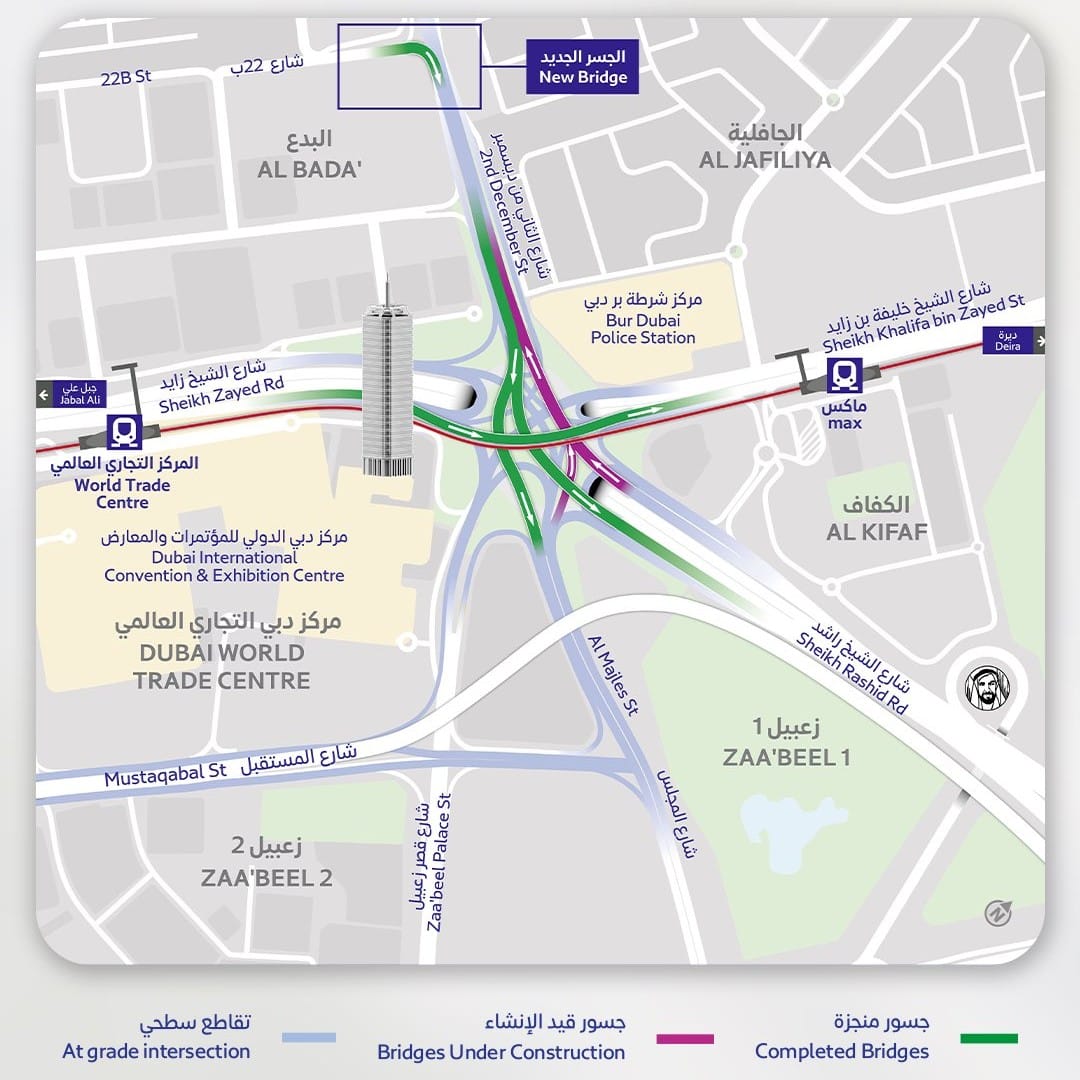
Dubai’s Roads and Transport Authority has opened a new 500-metre bridge under the World Trade Centre Roundabout Development Project.
The bridge is designed to improve outbound traffic movement from:
- Al Bada’a
- 2nd December Street
- Sheikh Rashid Road
- Al Mustaqbal Street
The single-lane bridge can accommodate up to:
- 1,200 vehicles per hour
Most importantly, it reduces travel time dramatically:
- From 8 minutes down to 2 minutes
For drivers using this corridor daily, that reduction represents a major operational improvement rather than a marginal upgrade.
Why This Area Matters
The World Trade Centre district remains one of Dubai’s most strategically important traffic zones.
The corridor sits close to:
- Sheikh Zayed Road
- DIFC
- Downtown Dubai
- Trade Centre
- Al Satwa
- Al Bada’a
Traffic pressure in this area has intensified alongside population growth, commercial expansion, and increased visitor activity.
The bridge project improves connectivity into Sheikh Zayed Road while distributing vehicle movement more efficiently across surrounding districts.
Part Of A Much Bigger Infrastructure Plan
The newly opened bridge is only one component of the wider World Trade Centre Roundabout Development Project.
The full project includes:
- 6 bridges
- Combined length of 5,000 metres
- Multiple free-flow traffic movements
- Upgraded junction systems
- New direct connectivity corridors
Earlier project milestones already included:
December 2025
Two bridges opened connecting:
- 2nd December Street
- Sheikh Rashid Road
- Al Majlis Street
- Al Mustaqbal Street
Combined bridge capacity:
- 6,000 vehicles per hour
February 2026
Another bridge opened linking:
- Sheikh Zayed Road
- Sheikh Khalifa Bin Zayed Street
Free-Flow Intersections Are Also Coming
One of the most important upgrades within the project is the conversion of existing signalised intersections into free-flow systems.
The junction serving traffic toward:
- Sheikh Rashid Road
- Al Mustaqbal Street
will now become a continuous-flow intersection rather than a stop-start signal system.
This matters because Dubai’s congestion strategy increasingly focuses on traffic continuity rather than simply adding lanes.
Reducing interruption points often creates significantly larger efficiency gains than road widening alone.
Dubai’s Smart Mobility Push Is Expanding Fast
While roads are being upgraded physically, Dubai’s public transport network is also becoming increasingly digitised.
RTA has now launched Dubai’s first fully integrated AI-powered smart bus station at Mall of the Emirates.
The station introduces a completely different approach to public transport infrastructure.
What Makes The Smart Bus Station Different

Unlike traditional bus stations, the new hub operates almost entirely through digital systems.
The facility includes:
- Real-time bus and Metro updates
- AI-powered crowd monitoring
- Smart occupancy tracking
- Digital ticketing
- nol card top-up systems
- Interactive kiosks
- Virtual assistants
- Taxi availability tracking
- Air quality monitoring
- Solar-powered energy systems
The station is directly connected to:
- Mall of the Emirates Metro Station
and serves:
- 11 bus routes
- 6 Metro feeder routes
- 3 internal routes
- 2 seasonal routes
Areas Connected Through The New Station
The smart station improves connectivity across several key communities including:
- Al Barsha
- Umm Suqeim
- Al Sufouh
- Al Manara
- Al Quoz
- The Greens
- Jumeirah Village Circle
- Arabian Ranches
- Dubai Science Park
- Dubai Studio City
It also improves access to:
- Dubai Miracle Garden
- Global Village
AI Is Now Managing Passenger Flow
One of the most notable features inside the station is its real-time occupancy system.
Passengers can now see:
- How crowded approaching buses are
- Live Metro timings
- Taxi availability
- Passenger distribution levels
This allows commuters to make more informed travel decisions while helping RTA distribute passenger demand more efficiently.
AI-powered cameras also monitor:
- Crowd movement
- Safety compliance
- Operational efficiency
- Violation detection
This transforms the station into a live operational intelligence system rather than simply a waiting area.
Sustainability Is Becoming Part Of Mobility Design
The station also reflects Dubai’s growing emphasis on sustainable infrastructure.
Features include:
- Solar panel integration
- Smart environmental sensors
- Energy-efficient systems
- Reduced operational waste
- Digitised customer services
Even the architecture follows RTA’s newer mobility philosophy, where transport hubs are expected to function as intelligent urban infrastructure rather than isolated transit points.
Dubai’s Larger Transportation Philosophy Is Becoming Clear
Across both projects, a clear pattern is emerging.
Dubai’s mobility strategy is no longer only about moving more cars or adding more roads.
The city is increasingly focused on:
- Predictive traffic management
- Integrated transport systems
- Real-time operational data
- AI-assisted infrastructure
- Sustainability
- Faster multimodal connectivity
The objective appears broader than congestion reduction alone.
Dubai is building a transportation ecosystem designed around speed, continuity, digital responsiveness, and long-term scalability.
The City’s Infrastructure Is Becoming More Predictive
Historically, infrastructure projects often reacted to existing congestion.
Dubai’s newer mobility projects increasingly anticipate future movement patterns before demand fully peaks.
That distinction is significant.
Whether through:
- free-flow bridges,
- AI-monitored bus systems,
- smart mobility corridors,
- Metro expansion,
- or future autonomous transport,
the emirate is gradually constructing a predictive transport model rather than a reactive one.
Final Thoughts
Dubai’s newest bridge and AI-powered bus station may appear like separate announcements, but together they reflect a deeper urban transformation.
The city is steadily redesigning mobility around:
- reduced friction,
- faster movement,
- smarter infrastructure,
- and digitally connected transportation systems.
From a two-minute bridge crossing near World Trade Centre to AI-assisted public transport hubs at Mall of the Emirates, Dubai continues pushing toward a future where movement across the city becomes increasingly seamless.
And increasingly intelligent.
Click here to learn more about opportunities for you
Click here to see what we offer


