
Dubai Metro Blue Line Moves Into Its Biggest Construction Phase
Dubai is continuing to refine Dubai has entered a major new phase in its transport expansion, with tunnelling works officially launched for the Dubai Metro Blue Line. The project is one of the city’s most important infrastructure developments, designed to connect fast-growing residential, academic, and business districts while reducing congestion across key corridors.
The Blue Line represents a Dh20.5 billion investment and spans 30 kilometres, with 15.5km underground and 14.5km elevated. Once complete, it will include 14 stations, serve around one million residents, and reduce traffic congestion by up to 20% along its corridors.
Set to open on 09-09-2029, the project continues Dubai’s tradition of linking major transport milestones to the original launch date of the Dubai Metro.
A Metro Line Built For Dubai’s Next Growth Phase
The Dubai Metro Blue Line is being developed to serve nine key districts expected to house approximately one million residents under the Dubai Urban Plan 2040. These include residential communities, education zones, and innovation districts that are already experiencing strong population and business growth.
The line will connect with the existing Green Line at Creek Station and the Red Line at Centrepoint Station, creating stronger integration across the wider metro network. It will also serve major areas such as Dubai Silicon Oasis, a key technology and knowledge hub, while improving access between eastern Dubai and the rest of the city.
For residents in areas such as International City, Al Warsan, Mirdif, and Dubai Silicon Oasis, the Blue Line is expected to significantly reduce dependency on cars, buses, and multi-transfer commutes.
14 Stations Across A 30km Route
The Blue Line will feature 14 stations across its route:
- 3 interchange stations
- 7 elevated stations
- 4 underground stations
The project includes several technically complex station designs, including the International City 1 interchange station, which will become the largest underground interchange station in the Dubai Metro network.
Spanning more than 44,000 square metres, the International City 1 station is expected to handle up to 350,000 passengers per day, making it one of the most important nodes in the future rail network.
A Direct Boost For Daily Commuters
For many residents in Dubai’s outer residential districts, daily commutes currently involve long road journeys, feeder buses, multiple transfers, and unpredictable peak-hour delays.
Routes from areas such as International City, Warsan, and Dubai Silicon Oasis to business hubs like Business Bay, Financial Centre, Deira, and Jumeirah Lakes Towers can often take over an hour during peak periods. Some public transport routes require several changes, while driving times are affected by congestion on corridors such as Sheikh Mohammed bin Zayed Road, Ras Al Khor Road, Al Khail Road, and Hessa Street.
The Blue Line is expected to change that pattern by creating faster and more direct rail connectivity. Journeys that currently take over an hour could potentially be reduced to under 40 minutes for several routes, depending on final station access and interchange timing.
This creates a more predictable commute, which is often just as important as a shorter one.
20-Minute Airport Connectivity
One of the most important benefits of the Blue Line is its planned connection to Dubai International Airport within approximately 20 minutes from supported corridors.
This strengthens the role of the Metro as a practical daily mobility system, not just a city transport network. For residents, students, professionals, and business travellers, faster airport access improves convenience while reducing road pressure.
The Blue Line also supports Dubai’s wider ambition to create a city where essential destinations can be accessed faster, with less reliance on private vehicles.
Al Wugeisha Begins Underground Tunnelling
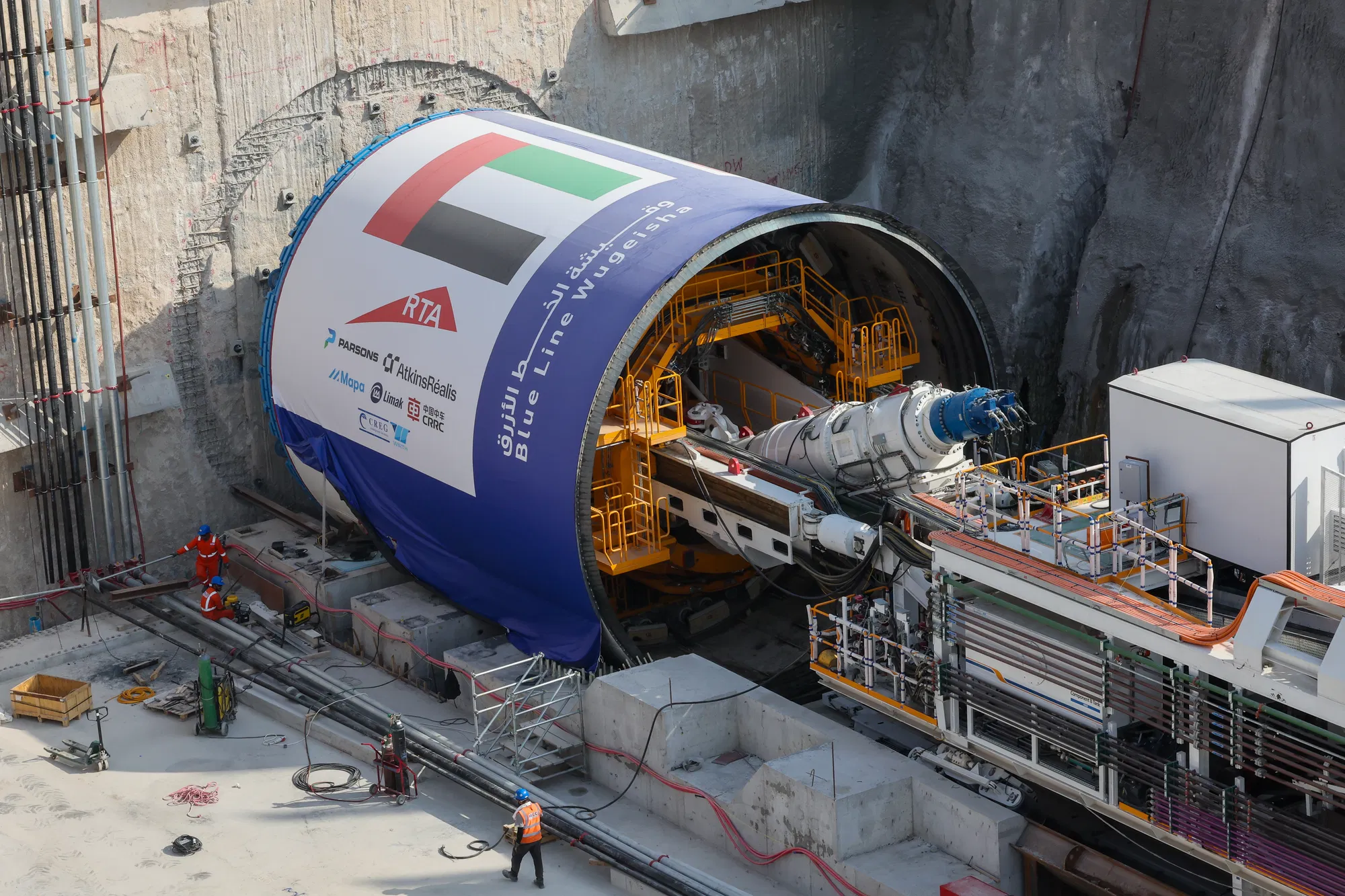
A major milestone in the project is the launch of underground tunnelling works using Al Wugeisha, the tunnel boring machine assigned to the Blue Line.
Named after a small desert rodent known in the UAE for its burrowing ability, Al Wugeisha is built for complex underground conditions, including hard rock, sand, and mixed terrain.
The machine is:
- 163 metres long
- 9.56 metres in diameter
- Over 2,000 tonnes in weight
- Capable of advancing 13 to 17 metres per day
- Equipped with digital guidance and advanced monitoring systems
Tunnelling will progress in three directions from International City 1 Station, heading toward Mirdif, the Auto Market, and Al Warsan / International City 2.
Why Tunnel Boring Technology Matters
Tunnel boring machines offer major advantages in dense urban environments. They reduce ground disturbance, improve safety, and allow underground works to progress with limited disruption to existing roads, buildings, and utilities.
Al Wugeisha is equipped with a powerful cutterhead, hydraulic thrust systems, spoil removal systems, and onboard control cabins. Its design allows the machine to create consistent tunnel walls while protecting surrounding ground layers.
This type of technology is particularly important in a city like Dubai, where infrastructure works must progress while daily life, traffic, and commercial activity continue around them.
Construction Already Moving Ahead
The Blue Line has already reached approximately 20% completion, with more than 10,000 workers and around 500 engineers and experts involved in delivery.
More than 13 million work hours have reportedly been completed without lost-time injuries, reflecting the scale and technical discipline behind the project.
The route was approved in November 2023, the contract was awarded in December 2024, and the foundation stone was laid in June 2025. Completion is expected to reach 30% by the end of 2026, with the full launch scheduled for 09-09-2029.
A Wider Metro Expansion Beyond The Blue Line
The Blue Line is part of a much larger rail expansion strategy. Dubai is also preparing for the future Gold Line, a separate Dh34 billion project that will further extend the metro network and support long-term mobility demand.
Together, the Blue Line and Gold Line represent a major expansion of Dubai’s public transport infrastructure. The wider aim is to build one of the most advanced, integrated, and visually distinctive metro networks in the world.
Dubai Metro and Tram currently extend across 101 kilometres, supported by 140 trains. Since launching in 2009, the network has carried nearly 2.8 billion commuters, with daily ridership now estimated at around one million passengers.
Impact On Real Estate And Key Districts
Transport infrastructure has always played a powerful role in shaping Dubai real estate demand. Improved metro access can increase the appeal of communities by reducing commute times, strengthening rental demand, and making districts more practical for end-users.
The Blue Line is particularly relevant for:
- Dubai Silicon Oasis
- International City
- Al Warsan
- Mirdif
- Creek area
- Academic and innovation districts
- Emerging residential corridors in eastern Dubai
For investors, metro connectivity often acts as a long-term value catalyst. It can improve liquidity, rental appeal, and end-user demand, especially in communities where road congestion has historically been a constraint.
Why The Blue Line Matters
The Dubai Metro Blue Line is not simply a transport project. It is a strategic urban planning tool designed to support population growth, improve quality of life, reduce congestion, and strengthen the city’s long-term competitiveness.
It connects where people live with where they work, study, travel, and invest. It reduces pressure on busy road corridors and gives residents a more reliable alternative to daily car dependency.
As Dubai continues expanding, projects like the Blue Line become essential to keeping the city efficient, accessible, and future-ready.
Final Thoughts
The launch of tunnelling works marks a critical step in one of Dubai’s most important transport projects. With a 30km route, 14 stations, one million residents served, and a 20% congestion reduction target, the Blue Line is set to become a defining part of the city’s next growth phase.
By 2029, daily movement across several key districts could look very different. For residents, commuters, businesses, and investors, the Blue Line represents a tangible shift toward a more connected Dubai.
Click here to learn more about opportunities for you
Click here to see what we offer


